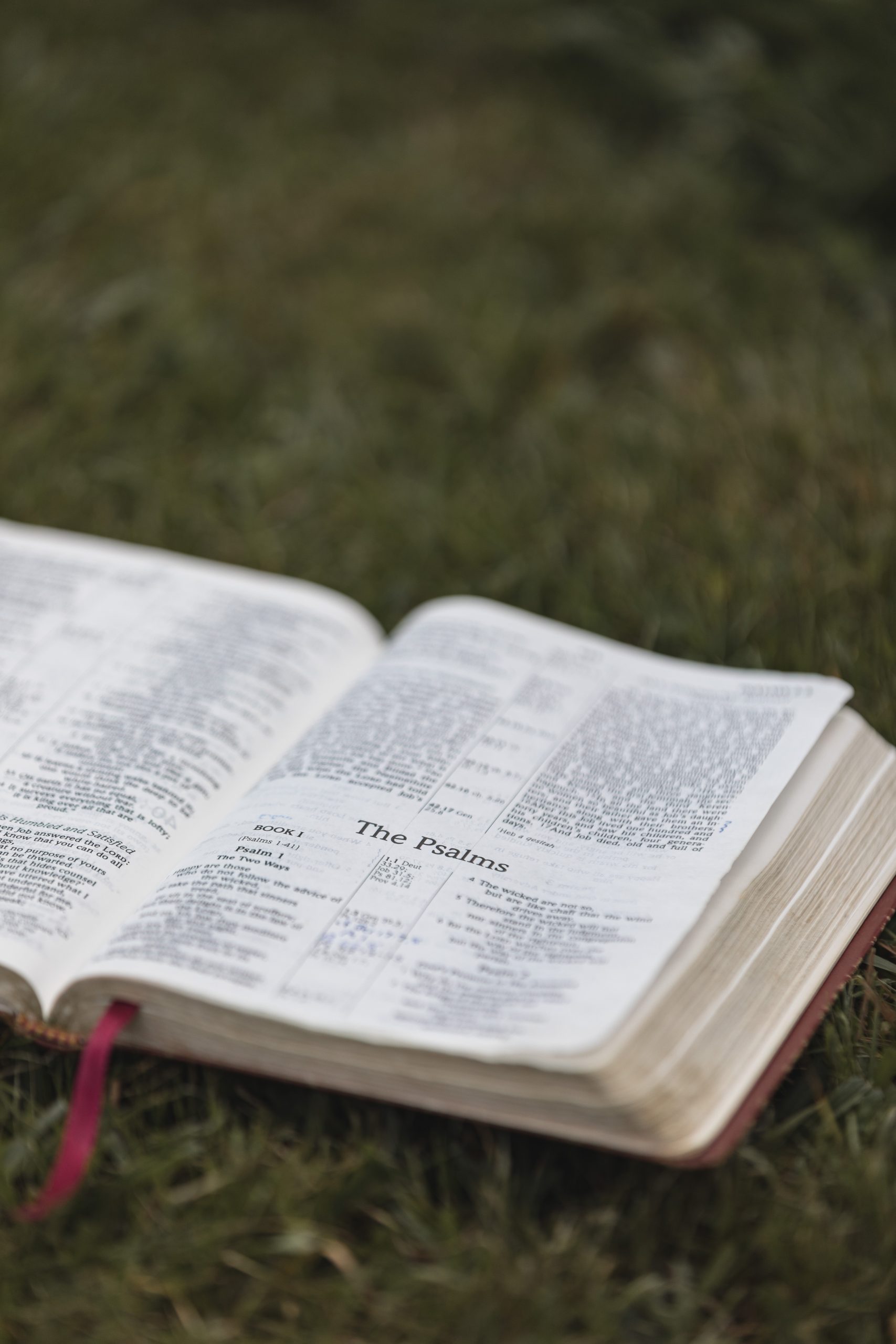
Psalm 1.
Psalm 23 is perhaps the best-known and most beloved chapter in all of Holy Writ. I was taught to memorise it in Sunday School as a child. Jesus quoted from the Psalms more than from any other Old Testament book. The words of the Psalms found expression in His teaching, as he debated the Jewish authorities, during his betrayal, and even in His suffering, as He hung on the cross.
All believers alike love the Psalms because they give voice to our emotions. Calvin, writing about the Psalms, said
“I have been accustomed to call this book, I think not inappropriately, an anatomy of all the parts of the soul. For there is not an emotion of which anyone can be conscious, that is not here represented in a mirror. Or rather, the Holy Spirit has here drawn to life all the griefs, sorrows, fears, doubts, hopes, cares, perplexities, in short, all the distracting emotions with which our minds are wont to be agitated.”
Both Ephesians 5:19 and Colossians 3:16 admonish us to speak to one another using the Psalms. And so, the Psalms are indispensable to the Christian life.
But how do we interpret it? In previous articles, we have explored the principles for faithfully interpreting Scripture: paying attention to the context into which it was written, and carefully looking for the meaning intended by the original author and how we can apply it to our contemporary situation. We’ve also emphasised how Jesus is the central theme of the whole Bible. So, how do these apply to the Psalms?
Psalms 1-2: The Gateway to the Psalms
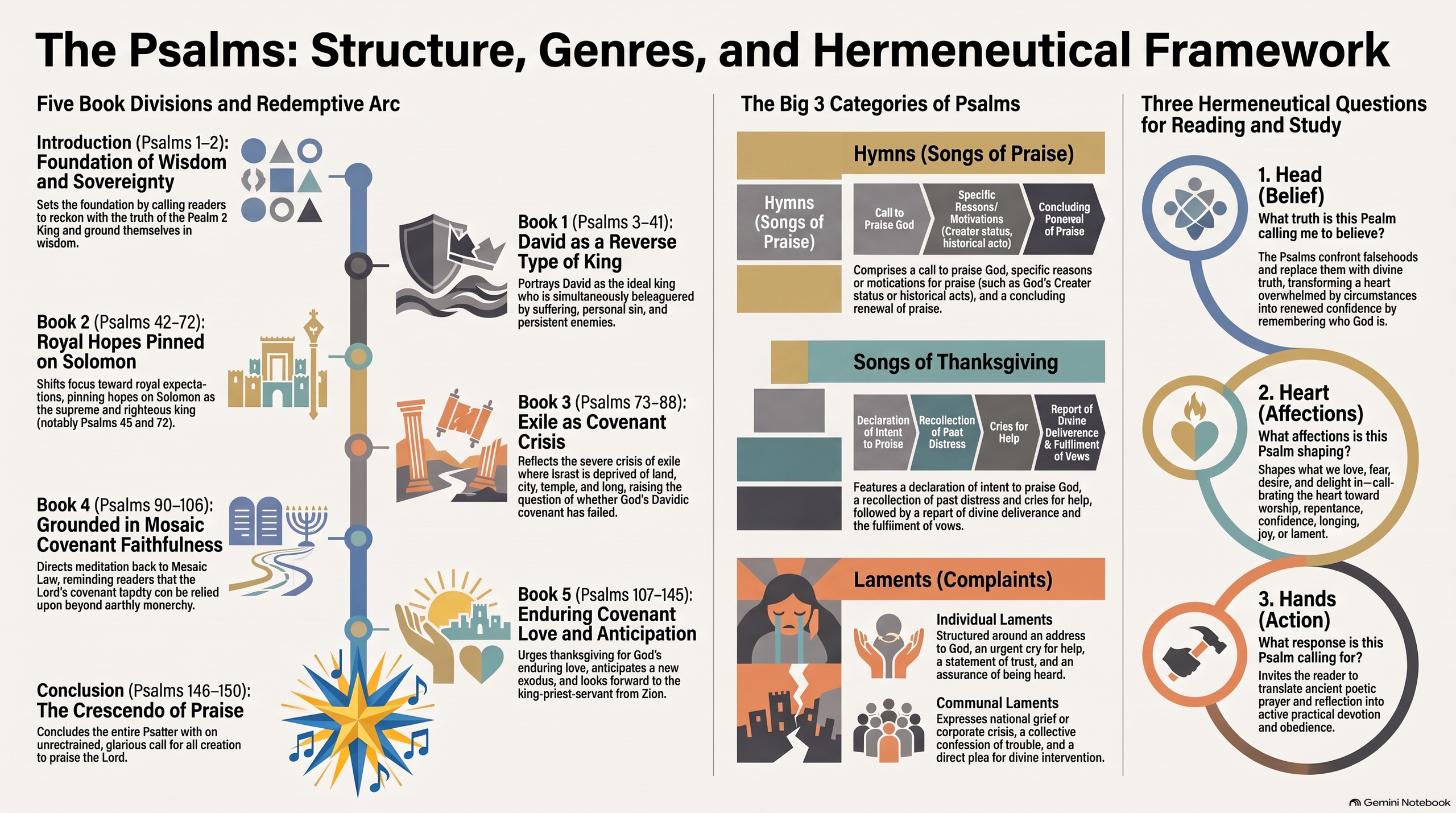
The Psalms have 150 chapters, divided into five books. You may notice that Psalms 1 & 2 have no superscriptions, unlike from Psalm 3 onward. That’s because Psalms 1 and 2 (Mark Furtado helpfully points out that Psalm 1-2 is probably a single psalm) introduce the book of Psalms, while Psalms 146-150 are praise conclusions known as Hallelujah Psalms (Hallel being the Hebrew for praise, and Yah the name of God). Book 1 runs from Psalm 3 through Psalm 42; book 2 spans Psalms 43-72; book 3, from Psalms 73-89; and book 5 covers Psalm 107 to Psalm 145. To discover the book’s purpose and the key to unlocking it, we need to pay attention to the introduction. That is the goal of this article.
The Way of the Blessed One
In Psalm 1:1, we are introduced to the blessed one. First, we are told what this person does not do: he does not walk in the counsel of the wicked, nor stand in the way of sinners, nor sit in the seat of scoffers. If you think about it, the three actions being described (walking, standing and sitting) encompass the spectrum of human activity. So, what we have here is essentially a way of life. Again, if we consider who these actions are done with – the wicked, sinners, and scoffers – they are essentially varied manifestations of the same way of life.
The Bible frequently contrasts the wicked with the righteous (see, for example, Genesis 18:23, Matthew 9:13). The book of Proverbs describes the wicked as those who spurn God’s commandments in pursuit of their own (sinful) desires. And Peter, writing in 2 Peter 3:3, says, ‘in the last days scoffers will come, scoffing and following their own evil desires’. Thus, the scoffer, the wicked and the sinner are alike in that their way of life is opposed to God’s commands. Here we are introduced to one of the literary devices the Psalms frequently employ, that of parallelism (common in Hebrew poetry), where the same thing is said two or three times, the second and/or third time intensifying or expanding the first. (Other literary devices worth paying attention to in the Psalms include repetition, comparisons and contrasts, and the use of images).
So, negatively speaking, the blessed man in our passage is not tinted by the way of life of sinners in any shape or form. Positively, “but his delight is in the law of the Lord, and on his law he meditates day and night.”
Delighting in the law of the Lord means loving it and doing it. Finding satisfaction in obeying the law of God. To meditate on the law of God means to intone it and mumble it to oneself. Hence, in the Bible, meditation is often closely linked with the mouth (see Joshua 1:8). This is where Biblical meditation differs from secular or contemporary approaches. While other forms of meditation encourage us to empty our minds, Biblical meditation calls us to fill our minds with Scripture.
Now what strikes me about the blessed man is that he meditates on God’s law day and night. That is the biblical way of saying ‘all the time’. So, this person not only delights in God’s law and obeys it but does so all the time. As a result, they are like a tree planted by streams of water: evergreen, stable, and fruitful in all seasons.
Seeing ourselves in the Psalms
When we read Psalm 1, we are immediately tempted to see ourselves in the blessed man. We reason something like this: the blessed one does not do so-and-so things, and so I need to avoid them. On the other hand, he does this-and-that, and so I should try to do them, and then I’ll be like that tree planted by the streams of water. Before we apply Psalm 1 to ourselves, however, let’s examine how the original readers of Psalms would have understood it.
In Deuteronomy 17:18-19, we encounter a very interesting command.
“And when he sits on the throne of his kingdom, he shall write for himself in a book a copy of this law, approved by the Levitical priests. And it shall be with him, and he shall read in it all the days of his life, that he may learn to fear the Lord his God by keeping all the words of this law and these statutes, and doing them.
These words were addressed to the King, which immediately reminds us that not everyone had access to the book of the law in those days. The priests were custodians of the law, and their duty was to teach it to the people. The King was to make a copy for his personal study, meditation, and obedience. Thus, the original readers of Psalm 1 would have immediately understood that the man in Psalm 1 to be the King. He was to be a man of the Book. In redemptive history, this was the time of David (half of the Psalms are attributed to him), so, in one sense, we can apply Psalm 1 to David.
But then we must ask the question: do the descriptions of the blessed man fit David? Was David sinless? Did he obey God’s law perfectly? Of course he didn’t, so he is a type of reverse King. He is expected to be this blessed man who perfectly obeys God’s law. But he really isn’t. In book 2, we meet Solomon, pictured as a high and righteous King (Psalms 45, 72). However, we know how his story ends. He is led astray by his many wives and compromises God’s commandments. So, he is also a reverse type of king.
But there’s one King who did not falter. Matthew 5:17 says Jesus fulfilled all the law and the prophets. 1 Peter 2:22 says He committed no sin, and no deceit was found in him (see also Acts 3:14; 1 John 2:1). Psalm 2 makes this even clearer.
The Son, God’s chosen King
In Psalm 2, we see that God has “set His King on Zion, His holy hill”. He is the one we should serve and fear (Psalm 2:11). More importantly, our blessing is tied to Him.
Kiss the Son, lest he be angry, and you perish in the way, for his wrath is quickly kindled. Blessed are all who take refuge in him.
Notice how Psalm 2 ends the way Psalm 1 begins. Herein, we are given the keys to interpreting the whole of the Psalms. Jesus, speaking to Cleopas and his friend on the road to Emmaus, said the law, prophets, and Psalms are fulfilled in Him. Acts 13:33 quoting Psalm 2:7 states that this Psalms 1-2 is fulfilled in Jesus. And so, the whole of the Psalms are fulfilled in Jesus. The King in the Psalms points to Jesus. Every Psalm therefore is fulfilled in Him.
Look at what is happening to the King in the Psalms
Bruce Waltke, in his book How (and How Not) to Read the Psalms, points out:
“The Psalter has a royal orientation. It is essentially a royal hymnbook with all the people of God gathered around the king at the temple.”
Thus, when we read ‘I’ in the Psalms, it is mostly referring to the King, not to us. Because the people’s welfare is tied to the King’s, ‘I’ and ‘we’ are often used interchangeably.
Michael LeFebvre is apt when he points out that the Psalms are
conversations with the covenanted king at the centre, in which the king is always at the centre, mediating our praise. But sometimes, the king speaks to the people in the psalms. Sometimes, the king leads the people in addressing God. Sometimes, the people sing to the king, or to God about the king or to one another before the king. The Psalms are full of changing voices singing ‘praising conversations’ with the covenanted king at the centre.
Blessed in the Son, our King
In closing, we come back to Psalm 1. Reading with our freshly acquired Christ-centred lens, we note that we are not the blessed ones; He is. We are, in fact, the wicked in Psalm 1, who will be destroyed unless we kiss the Son and pay allegiance to Him. The way of the wicked contrasts with the way of the righteous in that while the wicked perish in eternal judgment, those in the Son abide forever, like the tree planted by the streams.
The application is that the Son fulfils the law on behalf of all who trust in Him. Our blessing is bound up in Him. Once in Him, we imitate Him like beloved children (Ephesians 5:1). But our obedience does not guarantee our blessing; we are blessed because we are in Him.
Recommended resources for further study
I have been greatly helped by the Bible study series we are currently doing on the Psalms in our Church small groups. My Pastor, Ashley Gardner, has significantly shaped my understanding of the Psalms, along with several of the resources below.
- Christopher Ash: Teaching The Psalms Volume 1&2
- Introduction to the Psalms: NIV Zondervan Study Bible
- Christ in the Psalms, Ligon Duncan III: https://www.modernreformation.org/resources/articles/christ-in-the-psalms
- Psalms Talks, Vaughn Roberts, Keswick Convention: https://www.youtube.com/live/pCL_3P6KRuw
- Exile and Return, Nicolas Piotroski: https://www.crossway.org/articles/the-themes-of-exile-and-return-are-seen-throughout-the-psalms/?srsltid=AfmBOooPJu5-76m3HGgEHmR7VcfEG3-mEcLt4-Akn6hELapJeuy3pmGg
- Psalms: Bible Project: https://bibleproject.com/videos/psalms/
- The Psalms (Help Me Teach the Bible) Mark Furtado: https://www.thegospelcoalition.org/podcasts/help-me-teach-the-bible/mark-futato-on-psalms/
- The Psalms (Help Me Teach the Bible) Jim Hamilton: https://www.thegospelcoalition.org/podcasts/help-me-teach-the-bible/jim-hamilton-typology-psalms/
- The Glory Cloud Podcast, Old Testament Survey – Psalms: https://podcasts.apple.com/gb/podcast/the-glory-cloud-podcast/id1147518652?i=1000493361952
Author

Discover more from Peculiar Grace Fellowship
Subscribe to get the latest posts sent to your email.